
High-functioning autism and school refusal: How schools can respond

School refusal is often misunderstood. It can be viewed as a behavioural issue, a lack of motivation, or a reluctance to engage with education. However, for many autistic pupils, school refusal is not about unwillingness to learn. It is the result of anxiety, overwhelm, and unmet needs that have built up over time.
This is particularly true when considering the relationship between high-functioning autism and school refusal. Many pupils described as having high-functioning autism are academically able, verbally fluent, and capable of meeting expectations in the classroom. Because they appear to be coping, the challenges they experience are often overlooked until attendance begins to deteriorate.
As schools continue to grapple with rising levels of persistent absence, understanding why autistic pupils are more vulnerable to attendance difficulties has never been more important.
What is the link between high-functioning autism and school refusal?
The connection between high-functioning autism and school refusal is often misunderstood because the difficulties experienced by these pupils are not always visible.
The term “high-functioning autism” is not a clinical diagnosis, but it is still widely used to describe autistic pupils who do not have an intellectual disability and who may perform well academically. However, academic ability does not necessarily reflect a pupil’s ability to cope with the social, sensory, and emotional demands of school life.
Many autistic pupils work exceptionally hard to navigate environments that feel unpredictable, overwhelming, or exhausting. They may successfully complete assignments and achieve strong grades while simultaneously struggling with anxiety, sensory sensitivities, or difficulties forming and maintaining peer relationships.
Over time, this hidden effort can become unsustainable. When the demands of school begin to outweigh a pupil’s capacity to cope, attendance is often one of the first areas to be affected.
Is school refusal more common in autistic children?
Research consistently suggests that autistic pupils are more likely to experience attendance difficulties than their neurotypical peers. A 2025 scoping review examining school refusal in autistic children found strong links between attendance difficulties and factors such as anxiety, peer relationship challenges, bullying, and emotional distress.
Increasingly, professionals are moving away from the term “school refusal” and towards the concept of Emotionally Based School Non-Attendance (EBSNA), recognising that many pupils who struggle to attend school are experiencing genuine emotional distress rather than choosing not to engage.
For autistic pupils, this distinction is particularly important. Attendance difficulties are often a symptom of deeper challenges rather than a problem in themselves.
Why are academically able autistic pupils often missed before attendance declines?
One of the most significant challenges associated with high-functioning autism and school refusal is that academically successful pupils are often assumed to be coping.
Schools understandably monitor academic attainment, behaviour, and attendance as key indicators of wellbeing. However, autistic pupils can experience significant difficulties in all other aspects of school life while still maintaining academic performance.
Research has increasingly highlighted the role of masking, also known as camouflaging, in autistic pupils. Masking refers to strategies individuals use to hide or minimise autistic traits to fit into social environments. This might involve copying peers, rehearsing conversations, suppressing behaviours that help with self-regulation, or carefully monitoring social interactions.
While masking can help pupils navigate school environments, it comes at a cost, as autistic students feel the effects in the form of increased anxiety and lower levels of school belonging. Some of the pupils who appear to be coping best on the surface may actually be expending the most emotional energy just to get through the school day. By the time attendance begins to decline, these pupils may already have been struggling for months or even years.
What causes school refusal in pupils with high functioning autism?
1. Anxiety and emotionally based school non-attendance
Anxiety is one of the most common contributors to school refusal among autistic pupils. Some pupils experience anxiety around academic expectations, while others struggle with uncertainty, transitions, or social situations. For many, anxiety gradually becomes associated with the school environment itself. Eventually, the thought of attending school can trigger distress before the school day has even begun.
2. Sensory overload
School environments are filled with sensory demands. Corridors are crowded and noisy. Classrooms can be busy and unpredictable. Dining halls, assemblies, and break times often involve multiple sources of stimulation at once.
For autistic pupils with sensory sensitivities, these environments can be overwhelming. While individual challenges may appear manageable, the cumulative effect of navigating them every day can create significant stress. Over time, sensory overload can contribute to fatigue, anxiety, and eventual withdrawal.
3. Social exhaustion and masking
Social interaction is a central part of school life, yet it can also be one of the most demanding aspects for autistic pupils. Understanding social expectations, interpreting tone of voice, managing friendships, and responding to unspoken rules often require conscious effort. While many autistic pupils develop effective strategies for navigating these situations, doing so can be exhausting.
The result is that some pupils spend so much energy managing social interactions that they have little left for learning or emotional regulation.
4. Bullying and a lack of belonging
Research has consistently found that autistic pupils are at greater risk of bullying and social exclusion. Even when bullying is not present, many autistic pupils report feeling different from their peers or disconnected from the wider school community. A lack of belonging can significantly impact wellbeing and is increasingly recognised as a factor contributing to school avoidance.
What are the early signs of school refusal in autistic pupils?
- Before/after school: High anxiety on Sunday nights or mornings; complete emotional exhaustion or meltdowns immediately after getting home (“coke bottle effect”).
- Physical red flags: Poor sleep, headaches, stomach aches, or feeling physically sick before school.
- In the classroom: Withdrawing from or refusing to complete specific tasks/lessons; frequently asking to leave the classroom for “time out”; arriving late or skipping classes.
- Masking distress: Appearing “fine” or quiet at school while internalising massive distress until they get home.
Why attendance interventions often fail
Traditional attendance interventions tend to focus on improving attendance itself. While attendance is important, this approach can be ineffective if the underlying causes of absence are not addressed. Research involving autistic young people who experienced school non-attendance found that many described unmet needs, inadequate support, and difficulties within mainstream settings long before attendance deteriorated.
Understanding the reasons behind school refusal is important. Targeted support focuses on identifying barriers and reducing them, rather than viewing attendance as the problem in isolation.
Supporting pupils with high-functioning autism and school refusal
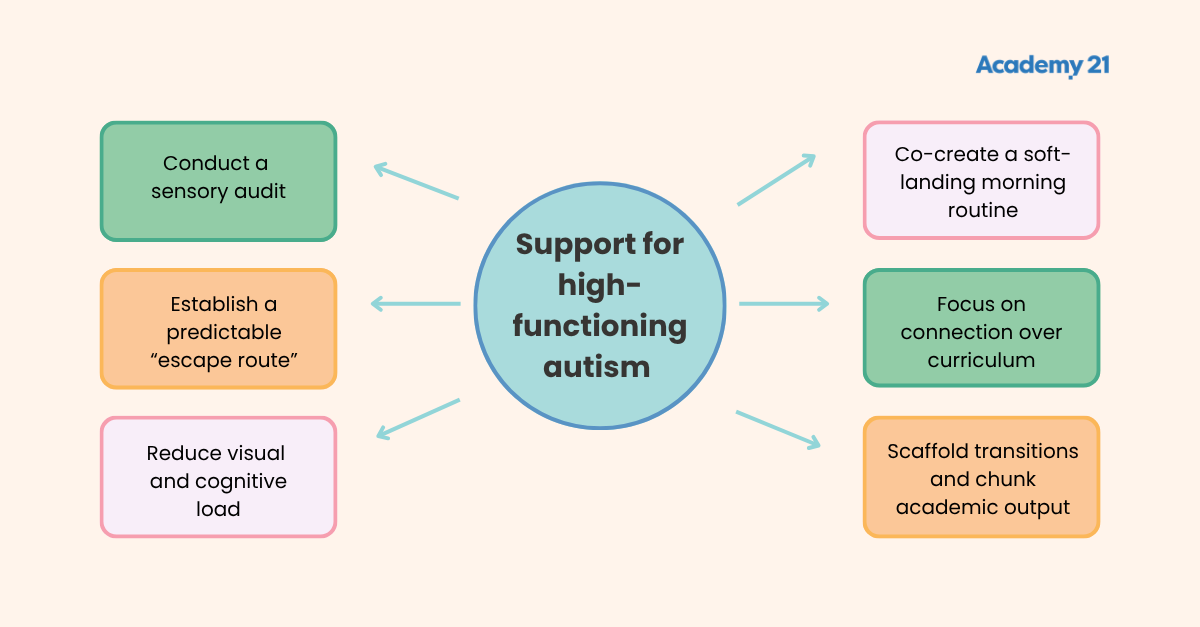
- Conduct a sensory audit: Identify what is draining their battery. Is it a loud lunchroom, bright fluorescent lights, or a chaotic hallway during lesson transitions? Allow them to leave lessons 5 minutes early to avoid crowded hallways, or provide a quiet space to eat lunch.
- Establish a predictable “escape route” If a student has to mask their distress until they explode, they will refuse to go to school. They need to know they can safely exit a stressful situation. One way to do this is by giving them a discreet “time-out card” or visual pass they can place on their desk to go to a designated safe, quiet room – no questions asked.
- Reduce visual and cognitive load: Unpredictability causes high anxiety. Clear, visual structures reduce the mental energy required to navigate the day. Use visual timetables. If a routine changes (like a substitute teacher or a room swap), give them as much advance notice as possible.
- Co-create a soft-landing morning routine: The transition from home to school is often the hardest part of the day. Allow them to bypass the chaotic main school gates or playground. Let them arrive 10 minutes early or late, entering through a quieter side door directly to a preferred staff member or safe room to regulate before lessons start.
- Focus on connection over curriculum: When a child is in a state of nervous system overload, they cannot learn. Adopt relational practice and prioritise making them feel safe and understood over hitting academic targets.
When should schools consider alternative provision?
For some pupils, mainstream attendance becomes temporarily unsustainable despite appropriate support. In these situations, alternative provision can play a vital role in maintaining educational engagement while reducing immediate pressures.
Academy21 provides live, teacher-led online learning for pupils who are unable to attend mainstream education due to anxiety, medical needs, or other barriers to attendance. This includes pupils experiencing autism-related school refusal or emotionally based school avoidance.
Online learning allows pupils to continue accessing a broad curriculum while learning in an environment that may feel safer and more manageable. Structured lessons, qualified teachers, and regular routines help maintain academic progress while schools, families, and support services work together to address longer-term needs.