
Developing an inclusion strategy: Leveraging the inclusive mainstream fund for systemic change

For many years, the education system has often operated under significant pressure, leading to reactive approaches to student support. We frequently find ourselves waiting for students to experience significant challenges before the necessary resources can be identified and secured. The introduction of the government’s Inclusive Mainstream Fund offers a vital opportunity to move toward a more proactive, sustainable model, but this shift requires us to rethink our traditional approaches to resource allocation.
For school leaders, the task is not simply to “make teaching inclusive.” It is to reimagine how we distribute our resources, define the learning environment, and deliver support that is both timely and durable. At Academy21, we recognise the immense pressure school leaders are under to achieve more with budgets that, while significant, remain stretched and varied across different regions.
To truly deliver on the promise of inclusion, we have the opportunity to embrace a shift: leveraging high-quality online provision as a strategic pillar of your school’s Inclusion Strategy.
The challenges in making use of the Inclusive Mainstream Fund
The £1.6 billion Inclusive Mainstream Fund is a significant investment, but the scale of the challenge – with one in three children requiring SEN support at some point in their schooling – means that we must be highly strategic. If this funding is dispersed too thinly, or used solely to maintain existing, over-capacity structures, there is a risk that the long-term impact will be limited.
Schools often face the challenge of balancing immediate needs with long-term goals. We frequently see capital directed into high-fixed-cost interventions, such as hiring additional staff or purchasing physical resources, that, while well-intentioned, can struggle to keep pace with the diverse and evolving needs of a student body. Similarly, the creation of inclusion bases can sometimes become an unintended burden on staff time and operational budgets, rather than the specialist hub we intend them to be.
The objective is to move away from maintaining the status quo and toward investing in more flexible, scalable solutions. When a school’s strategy is limited to replicating strained onsite provision, it can be difficult to achieve the same level of impact as a more collaborative, hybrid approach. We have the chance to move beyond the assumption that inclusion is defined solely by physical presence and instead use this funding to build an infrastructure that provides immediate access to expert-led interventions, regardless of a school’s size or location.
This helps school leaders to move towards a more responsive model, stepping away from the costly overheads of maintaining traditional facilities that may not always be optimally utilised. Instead, schools can invest directly in high-quality academic and pastoral support, scaling resources to match the actual needs of their students exactly when and where it matters most.

Why online provision is a strategic essential
1. Decoupling support from geography
In many regions, schools face real difficulties in sourcing the specialist provision needed to meet the diverse requirements of their students. Relying solely on local, in-person specialists can lead to long waiting lists and inconsistent support.
By integrating DfE-accredited online provision, schools can provide immediate, live, subject-specialist teaching to students wherever they are. This is not about separating students; it is about providing a stable and focused environment where they can build the confidence required for success, often working in tandem with the pastoral support they receive within their physical school setting.
2. Scalable, data-driven targeted support
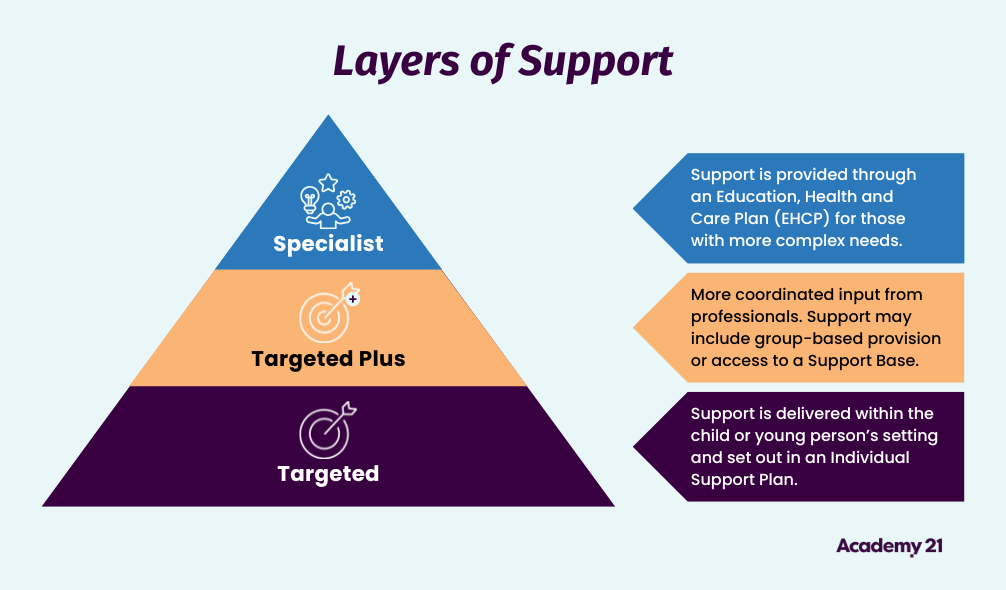
The new focus on “Targeted” and “Targeted Plus” support requires schools to have evidence-based interventions ready to deploy. Academy21’s model allows schools to scale support up or down based on the specific, evolving needs of the student, providing flexibility that is difficult to achieve with fixed-term staffing contracts.
Whether a student needs a full curriculum of core subjects or a specific intervention to build literacy or numeracy confidence, schools can commission exactly what is needed, when it is required. This flexibility ensures that the Inclusive Mainstream Fund is directed toward measurable student outcomes, rather than being absorbed by administrative overheads.
3. Creating a "safe harbour" for inclusion
Inclusion is ultimately about ensuring that every student feels they belong. For a student experiencing significant social anxiety or behavioural barriers, the traditional mainstream classroom can sometimes feel like a place of exclusion. By using high-quality online learning as a core part of your provision, you create a “safe harbour.”
Many of our students start their journey in a calm, supported online environment where they can engage directly with expert teachers in small groups. Because the digital environment is structured, students often feel more empowered to participate and engage with the curriculum. Once this foundation of confidence is established, the transition back to the wider mainstream classroom is a structured, evidence-led progression.
Building your inclusion strategy: A practical framework
As you draft your mandatory Inclusion Strategy, consider moving beyond the internal school wall to create a multi-layered ecosystem:
- Universal offer: Enhance your high-quality, adaptive teaching for all students by using online professional development and subject-specialist curriculum support, ensuring your staff are empowered to handle a wide range of needs.
- Targeted offer: Instead of building a resource-heavy internal unit, use your budget to commission high-quality online provision that provides core academic curriculum under the supervision of a dedicated school-based mentor. This allows your onsite staff to focus their expertise on the essential pastoral and social support that is most effectively delivered face-to-face.
- Targeted plus/specialist offer: Utilise online provision for students who require significant adaptations to the curriculum or those whose needs make traditional classroom attendance temporarily impossible. This ensures their education remains consistent and of high quality, even when their personal or medical circumstances change.
A call for collaborative growth
The £1.6 billion Inclusive Mainstream Fund is a catalyst for change. If we funnel this investment into the same rigid, bricks-and-mortar structures that have struggled to keep pace with rising needs, we risk missing the opportunity for genuine progress. True leadership requires us to think differently.
For Academy21, inclusion is about removing barriers. It is about creating environments – whether physical or digital – where every child feels safe enough to learn, seen enough to belong, and supported enough to achieve.
The path forward requires us to stop acting as isolated settings and start collaborating as a unified network. By pooling resources and integrating proven digital expertise into your mainstream strategy, you can stretch your funding further and ensure that high-quality specialist support is the rule, not the exception.
Are you ready to design a strategy that works for your students and your budget? Let’s partner to bridge this gap. To learn more about how Academy21 can support your school’s Inclusion Strategy, contact our regional partnership team today. Together, we can build an education system that truly works for everyone.