
Inclusion bases and Enhanced Resource Provision: Delivering SEND Reform beyond infrastructure

The publication of Every Child Achieving and Thriving marked a decisive shift in how inclusion is positioned within the education system, moving it away from an aspirational principle and into something far more concrete: an operational expectation that schools, trusts, and local systems are now required to deliver consistently.
More children and young people should have their needs met within mainstream education, support should be introduced earlier and with greater precision, and the system should move away from patterns of escalation that result in pupils reaching a crisis point before meaningful intervention is put in place. Alongside this, there is a clear expectation that no child should be left without a suitable education, regardless of the barriers they may face to accessing a physical setting.
Inclusion bases are key to translating this ambition into practice. However, while the expansion of provision represents a significant and necessary step forward, it does not, in itself, resolve the more complex challenge embedded in the White Paper’s vision. Building provision is one part of the solution, but it’s just as vital and urgent for provision to be deployed flexibly, immediately, and in alignment with a pupil’s needs.
What are inclusion bases?
Inclusion bases are, in essence, proposed to be specialist provisions embedded within mainstream schools, designed to support pupils who require more targeted intervention than standard classrooms can deliver, but who do not necessarily require a full-time specialist placement.
Traditionally, internal AP focused on relatively well-defined groups of pupils, often those with communication and interaction needs or specific learning profiles that benefit from smaller-group environments and more structured support. What is notable in the current landscape is the extent to which their role has expanded beyond these original parameters.
Schools are now using inclusion bases or similarly named provision to support a much wider cohort of pupils, including those experiencing anxiety-related school avoidance, those whose attendance has become inconsistent, and those who are beginning to disengage from education in ways that are not always captured by formal SEND identification processes. These needs are more complex and less predictable.
Online alternative provision specialists like Academy21 provide DfE-accredited, flexible education that can be moulded to fit existing internal AP settings and enhance resource provision, maintaining continuity of learning when physical attendance is disrupted.
Generally, this shift to internal AP and more flexible options within mainstream settings reflects a system that is attempting to intervene earlier and more effectively, but it also changes the nature of the demand being placed on inclusion bases. They are no longer working solely with stable, clearly defined needs; they are increasingly responding to dynamic situations in which engagement, attendance, and learning can fluctuate over relatively short periods.
What the White Paper sets out for inclusion bases
The new SEND White Paper establishes a framework that is built around early intervention, graduated levels of support, and a stronger expectation that mainstream settings can deliver inclusive education without relying heavily on specialist placements.
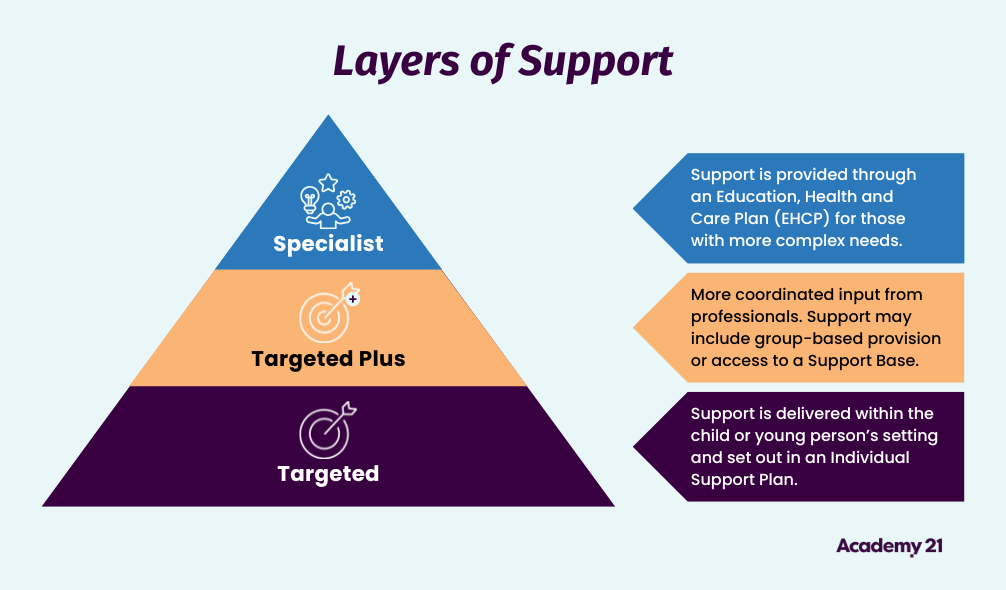
The introduction of Individual Support Plans, alongside the Universal, Targeted, and Targeted Plus structures, is intended to create a more coherent and responsive system that tailors support to each pupil’s needs.
Inclusion bases are clearly positioned as a key mechanism for delivering targeted and targeted-plus interventions within mainstream schools. However, the practicalities of implementing these aren’t as straightforward.
The policy assumes support can be implemented “instantly” as needs evolve. In reality, schools often face a “resource gap” between identifying a need and the physical arrival of specialist staff or funding, leaving pupils in a high-stakes waiting period where learning is easily disrupted.
A further challenge lies in curriculum continuity for pupils with inconsistent attendance. While the government expects schools to maintain a seamless education for those unable to access in-person learning, the logistical reality of managing a hybrid model is immense.
Without a dedicated digital bridge, some schools struggle to ensure that pupils remaining off-site for SEMH or medical reasons stay aligned with their peers, often leading to an “attainment slide” that makes eventual reintegration much more challenging. At Academy21, we have seen this firsthand, as 65% of students joining us have been assessed by their schools as achieving below age-related expectations.
Online alternative provision can operationalise the White Paper’s core assumptions and requirements. With immediate access to DfE-accredited provision, fully online, adaptable to existing timetables, and flexible to support every need, schools can deploy high-quality teaching at the exact point where a pupil’s need first emerges.
Where inclusion bases meet their limits in practice
There is broad agreement on the importance of inclusion and on the need to respond earlier and more flexibly to pupils’ needs. The difficulty lies in delivering this within the constraints of existing capacity.
Inclusion bases, for all their value, remain structured forms of provision. They depend on staffing, physical space, and timetabling, all of which are finite and often already under pressure. They also require a level of coordination and consistency that can be difficult to maintain when the needs they are responding to are constantly shifting.
The current profile of need within schools adds further complexity. Pupils are not presenting with static, easily categorised needs; rather, they are experiencing patterns of disengagement, anxiety, and disrupted learning that can change rapidly. Attendance may fluctuate from week to week, and the window for effective intervention can be relatively short.
Timing becomes critical. The principle of early intervention is widely understood, but it can only be realised if support is available when it is needed. Where there is a delay between identifying need and implementing provision, the situation can escalate, making subsequent intervention more challenging and less effective.
Extending inclusion through flexible, immediate provision
If inclusion is to function as the White Paper envisages, it requires access to support that can be deployed quickly, adapted over time, and aligned with a pupil’s ongoing learning.
At Academy21, online learning is positioned as part of the broader inclusion infrastructure that supports schools in delivering mainstream education more effectively. We have immediate capacity and can onboard new students within two working days to address needs as they arise.
The flexibility of this model allows the provision to be tailored to the individual pupil. It can be delivered on a part-time or full-time basis, integrated into a school timetable, or used as a short-term intervention to support reintegration. This aligns closely with the intent behind Individual Support Plans, which require provision to be tailored, responsive, and capable of evolving as a pupil’s needs change.
Many of the schools we work with are already deploying Academy21 within their Inclusion Hubs, using us to deliver targeted teaching and pastoral support in a calmer setting that remains very much part of the school environment.

Evidence of impact: engagement, progress, and reintegration
The effectiveness of this approach is reflected in the outcomes achieved by pupils who access online provision through Academy21. Many of these pupils arrive having experienced significant disruption to their education, often following prolonged absence or periods of disengagement. Despite this, the majority make measurable academic progress within a relatively short period. Of pupils who had previously recorded no attendance in their prior setting, 85% go on to attend live online lessons with Academy21, demonstrating that re-engagement is possible even in cases of severe disruption, so long as the provision is accessible and timely. Furthermore, 93% of our learners reported increased confidence in their learning, a key precursor to successful reintegration into full-time mainstream.
We are proud to be the first online AP accredited by the DfE and to consistently demonstrate high standards of safeguarding, teaching quality, and provision. But we are equally proud of our flexible approach – working closely with schools, LAs and education settings to deliver truly bespoke solutions, act quickly, and provide the support every student needs, when and where they need it.
A more integrated model of inclusion
The expansion of inclusion bases and the enhanced provision of resources represent meaningful progress towards a more inclusive system. It reflects a commitment to meeting needs within mainstream education and to reducing reliance on specialist placements.
However, delivering on the full ambition of SEND reform requires a system that can respond at the point of need, not simply one that has increased its overall capacity. It requires a provision that is not only high-quality but also accessible, adaptable, and deployable without delay.
Online provision already meets many of these requirements, and its role within the inclusion landscape is becoming increasingly significant as schools seek ways to operationalise the White Paper’s intent. The tools to deliver inclusive, flexible education already exist; they just need to be integrated effectively within inclusion bases to realise the ambitions set out in the White Paper.
If you have any questions on how Academy21 can support your SEND plans, please contact our team. We would love to work with you to support your students.