
De-escalation strategies in schools: Practical approaches that work
Managing students’ behaviour effectively is central to creating a safe and productive learning environment. With many schools now teaching pupils with increasingly complex social, emotional, and mental health needs, alongside the lasting impact of disrupted learning in recent years, this has become an important challenge for school leaders.
By recognising early signs of distress and responding in ways that reduce tension, schools can often prevent situations from escalating. But the benefits of knowing how to respond calmly to escalating situations extend beyond the school environment, protecting relationships and helping your pupils regulate their emotions in their day-to-day lives.
So, what are de-escalation strategies in a school setting, and how can they support behaviour management across the whole school?
What is de-escalation in a school context?
De-escalation involves using proactive strategies to calm a situation when a student shows signs of agitation, distress, or defiance. It is grounded in the understanding that behaviour is often a form of communication, where a student may be stressed, experiencing sensory overload, or responding to unmet emotional needs. Recognising these signals allows staff to intervene before behaviour becomes more difficult to manage.
The goal of de-escalation strategies is to prevent situations from reaching a crisis point where a student could harm themselves or others.
Why de-escalation strategies matter more than ever
Research has found some behaviour policies do not always elevate de-escalation strategies. Instead, the focus may jump to sanctions such as detention, suspension, or exclusion. For many, these consequences play an important role in securing a safe environment however when using consequences to secure compliance, many also call for an equal focus on the underlying causes of behaviour and creating environments where undesirable conduct is made less likely to occur.
Schools are increasingly serving students affected by adversity and with complex emotional needs. The Department for Education’s Behaviour in Schools guidance emphasises that schools should adopt proactive behaviour strategies that support pupils in regulating their emotions and maintaining engagement in learning.
De-escalation strategies have therefore moved from a “nice-to-have” in the classroom to a necessity:
Rise of SEND and SEMH needs
The rise in students with SEND and SEMH needs requires a shift away from binary “zero tolerance” models toward a more nuanced integration of support. While traditional consequences and clear boundaries remain essential for maintaining school-wide structure, relying solely on reactive measures can trigger a “fight or flight” response in vulnerable learners. The most effective approach isn’t a choice between inclusion and discipline, but a strategic mix of both – pairing firm, predictable standards with the flexibility to address the emotional triggers that underpin a student’s behaviour.
Post-pandemic education
Since 2020, research from Ofsted and the Education Endowment Foundation (EEF) has highlighted a sharp rise in student anxiety and emotional dysregulation. According to Ofsted’s 2024 research, the “consequences of lockdowns” mean many children (particularly those entering school during the pandemic) missed crucial windows for social-emotional learning, leading to delayed communication skills and significant difficulties in self-regulation. Furthermore, a 2024 Save the Children survey of over 6,000 teachers found that 89% reported a visible increase in social and emotional issues, noting that students often display lower frustration thresholds and heightened stress levels as they struggle to bridge the “social-emotional gap” created by disrupted schooling.

Trauma-informed practice
UK schools are increasingly adopting trauma-informed approaches, recognising that behaviour once labelled as misconduct may be linked to Adverse Childhood Experiences (ACEs) such as family instability, abuse, or exposure to substance misuse.
Staff retention and wellbeing
According to Education Support, a UK charity supporting teacher and education staff wellbeing, 76% of education staff report feeling stressed and 86% of senior leaders say they are burnt out or exhausted. Persistent behavioural conflict can contribute to staff fatigue and reduced wellbeing, with some even leaving the profession.
De-escalation strategies help schools respond to these challenges by recognising the emotional and neurological factors behind behaviour and providing practical ways to prevent escalation.
Practical de-escalation strategies for the classroom
De-escalation requires teachers and staff to remain calm and regulated themselves, modelling the sense of safety students need. After all, a dysregulated adult cannot support a dysregulated child.
The Education Endowment Foundation’s Improving Behaviour in Schools guidance highlights the importance of clear routines, supportive relationships, and consistent responses when managing challenging behaviour.
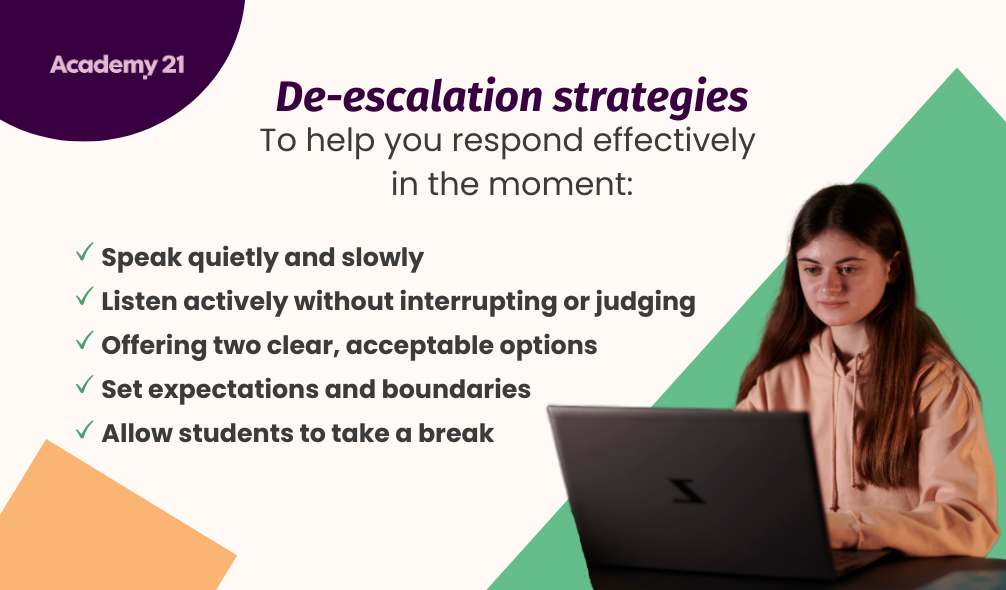
The following de-escalation strategies can help you respond effectively in the moment:
- Low and slow: Speak quietly and slowly. Lowering your voice encourages students to quieten down, while slowing your pace signals safety and calm.
- Empathetic listening and validation: Listen actively without interrupting or judging. Acknowledge how the student feels without necessarily agreeing with their behaviour.
- Clear, simple choices: Agitated students often feel powerless. Offering two clear, acceptable options can help them regain a sense of control – for example, “Would you like to work at your desk or in the quiet corner?”
- Set expectations and boundaries: Remind students of behaviour expectations in simple terms. Focus on the behaviour, not the person, to avoid power struggles.
- Time and space to cool down: If tension rises, allow students to take a break or move to a designated calm space. Give them the time they need to breathe and regain composure.
In addition, consistency and predictability are key. Pupils notice how adults respond when situations become difficult.
When responses remain consistent, pupils learn what to expect – even during their most vulnerable moments. That predictability helps them feel safer and more supported. Inconsistency, however, can be the biggest trigger for escalated behaviour.
Whole-school approaches to prevent escalation
For school leaders, effective de-escalation goes beyond individual classroom interactions. By developing clear policies and fostering a collaborative culture, schools are better equipped to address conflicts before they escalate. Whole-school approaches help create proactive, supportive environments through clear routines, restorative practices, and the explicit teaching of social and emotional skills.
Schools can embed de-escalation into their culture and systems through:
- Relational practice: a deliberate, school-wide commitment to building strong, respectful relationships between staff, students, and families. This covers regular communication, restorative conversations, and staff modelling respectful interactions with pupils.
- Trauma-informed practice: ways of teaching, interacting in and organising learning environments that acknowledge the prevalence and impact of trauma on students. Schools often implement this through predictable routines, emotionally safe classrooms, and staff training on recognising and responding to trauma-related behaviour.
Staff training and development are an invaluable part of creating a whole-school approach to sustainable behaviour management. Comprehensive professional development equips all educators with the skills to recognise triggers and respond relationally rather than punitively.
Taking a step back and doing regular reflection sessions on behaviour in the school helps to identify what’s working. Sharing experiences and techniques can also reduce burnout and improve implementation.
When additional support might be needed
Challenging behaviour in the classroom may require more than real-time de-escalation. Some students need additional interventions to help them reset and re-engage with learning. In these situations, flexible online alternative provision can be a supportive option that gives pupils a safe space and a “cooling-off” period to regulate their emotions while continuing their education. Short-term placements can help break cycles of disengagement, giving pupils time to rebuild confidence and re-establish positive routines.
At Academy21, we support schools with DfE-accredited online alternative provision that adapts to the needs of both pupils and their schools at any given time — whether that means a short period of support or a longer intervention. With enrolment possible within 48 hours, and commissioning options tailored to specific needs, pupils can continue learning in a structured environment while behaviour and wellbeing strategies are put in place. This provides targeted support for pupils who need additional time and structure.
In addition to structured online learning aligned with the UK curriculum, our teachers are all trained in relational and trauma-informed practices and are experienced in supporting students with a variety of needs.
Our calm and welcoming environment, with small-group classes and personalised teacher support, allows young people to reset. We also have comprehensive pastoral support, including wellbeing courses such as anxiety management and social skills, as well as one-to-one counselling, and monitor students daily to ensure they continue to receive the right support at the right time.
Adopting a whole-school perspective
De-escalation strategies in schools are most effective when they form part of a consistent, whole-school approach that prioritises relationships, emotional regulation, and proactive interventions. When schools combine practical classroom strategies with trauma-informed culture and additional expert provision, they can create calmer environments where pupils remain engaged in learning and are better supported to succeed.
Contact our team to learn more about our bespoke options or refer a student.