
Positive Behaviour Support Plan: What is it and how to build one

When a child’s behaviour disrupts learning, puts themselves or others at risk, or affects their overall wellbeing, the instinct is often to respond with sanctions or punishment. Yet reactive approaches alone rarely solve the problem. In fact, they can exacerbate behaviours or damage relationships between staff and pupils. As an education leader, you have likely encountered situations in which a student repeatedly interrupts class, argues with peers, or challenges teachers’ authority, and know how punitive actions often exacerbate this behaviour.
But even more effective than reacting compassionately and empathically is to build an approach that structures and formalises your school’s response. Enter Positive Behaviour Support Plans (PBSP), which aim to understand the why behind behaviour and provide targeted support to help pupils succeed. Let’s explore what these plans encompass and whether you could consider adopting them in your organisation.
What is a Positive Behaviour Support Plan?
A Positive Behaviour Support Plan is a customised, preventative and proactive approach, sometimes trauma-informed and attentive to mental health, for anybody who displays disruptive behaviours, be it adults or children, including:
- Children in educational settings (schools, nurseries, or specialised programmes)
- Adults in workplace or community environments
- Individuals with neurodevelopmental conditions (such as autism and ADHD)
- People with mental health challenges who may exhibit challenging behaviours
- Individuals in residential or care settings (supported living, care homes)
- Persons involved in the criminal justice system where behavioural support is needed
- Anyone experiencing situational stressors that lead to disruptive or unsafe behaviours
The Challenging Behaviour Foundation highlights that behaviours a person enjoys or uses to express themselves are not inherently “wrong.” Often, they are a way for the individual to feel seen, heard, and understood.
Instead of relying on punitive methods, a Positive Behaviour Support Plan focuses on seeking to understand the underlying reasons for someone’s actions. These causes can be varied, including:
- Physical challenges – pain, sensory sensitivities, fatigue, medical conditions, or mobility difficulties.
- Trauma or past experiences – adverse experiences that affect emotional regulation and responses.
- Mental health difficulties – conditions such as anxiety, depression, ADHD, or other psychological factors.
- Environmental factors – stressful or unsafe home, school, or workplace situations.
- Socioeconomic factors – poverty, instability, or lack of access to support and resources.

The benefits a Positive Behaviour Support Plan can bring
Promoting inclusivity and compassion
Traditional approaches in education often rely on punishment to manage challenging behaviour. While intended to reduce disruption, these methods can make pupils feel ashamed and may even worsen the behaviour.
By comparison, these plans rely on compassionate and inclusive methods to minimise the same ways of functioning. In its Competence Framework, the NHS highlights the value of personalised treatment, community involvement, and supportive activities, all of which help reduce feelings of low self-worth and create a more positive learning environment.
Decisions are evidence-based and effective
Because Positive Behaviour Support Plans are grounded in careful observation, every strategy is based on real, verifiable information about the individual. By monitoring behaviour step by step, educators and support staff can see what works and what doesn’t. This ensures that interventions are tailored, effective, and continuously improved, giving the individual the best chance to develop positive behaviours and succeed.
Improves communication and community
Through its non-punitive measures, these plans create a safe space for dialogue where pupils feel comfortable to voice what is happening within themselves and their external environment that might be causing them distress. Communication also strengthens connections with others, improving overall wellbeing and reducing disruptive behaviours.
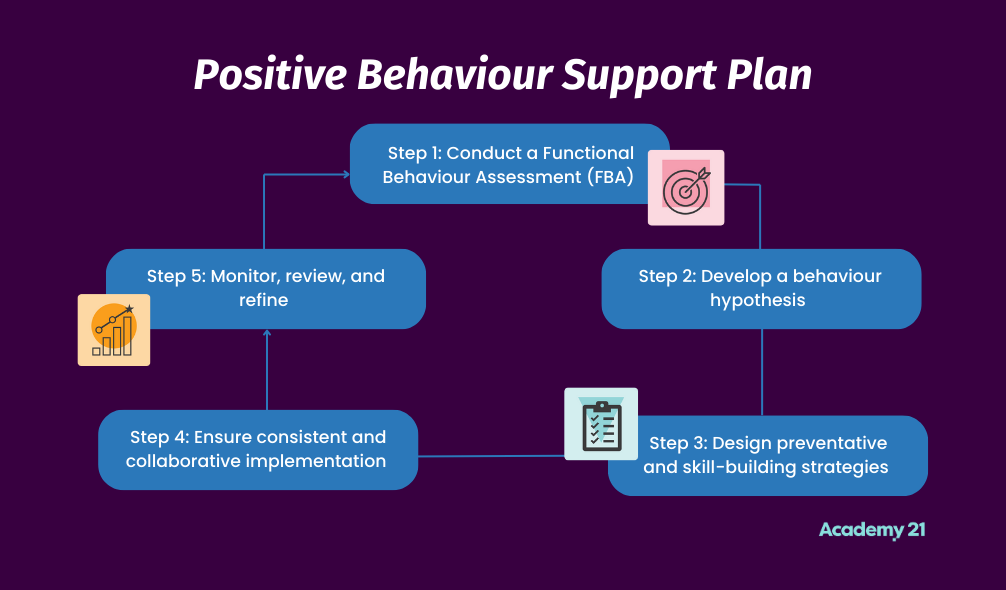
What a typical Positive Behaviour Support Plan process looks like
Step 1: Conduct a Functional Behaviour Assessment (FBA)
The process begins with a Functional Behaviour Assessment (FBA), a structured method for gathering information to understand why a behaviour occurs. Rather than focusing solely on the behaviour itself, the FBA examines patterns surrounding it: what happens before the behaviour (antecedents), what the behaviour looks like in observable terms, and what happens afterwards (consequences).
This assessment seeks to determine the function of the behaviour. In many cases, behaviour serves a purpose, such as:
- Gaining attention
- Escaping or avoiding a task or situation
- Accessing a desired object or activity
- Responding to sensory needs
By identifying these patterns, educators and caregivers move away from assumptions and towards evidence-informed understanding
Step 2: Develop a behaviour hypothesis
Based on the FBA findings, a clear, testable hypothesis is developed. This hypothesis explains the likely function of the behaviour and provides a foundation for intervention. Rather than labelling behaviour as “defiant” or “disruptive,” the hypothesis reframes it as purposeful and responsive to specific triggers or needs.
For example, a child may display confrontational behaviour during group work because social interaction triggers anxiety, and the behaviour allows them to avoid the situation. This hypothesis guides the next stage of planning and ensures strategies are targeted rather than reactive.
Step 3: Design preventative and skill-building strategies
With a hypothesis in place, the Positive Behaviour Support Plan outlines proactive strategies. These typically include:
- Environmental adjustments to reduce known triggers
- Clear and concise behavioural expectations tailored to the setting
- Direct teaching of replacement behaviours, such as communication skills or emotional regulation techniques
- Positive reinforcement strategies to strengthen appropriate behaviours
The emphasis is on teaching new skills and modifying contexts, rather than simply discouraging unwanted conduct.
Step 4: Ensure consistent and collaborative implementation
For this plan to be effective, it must be applied consistently across relevant environments. It often involves collaboration between teachers, support staff, families, and, where appropriate, external professionals. A predictable, supportive environment increases the likelihood that new behaviours will be practised and sustained.
Step 5: Monitor, review, and refine
Ongoing data collection is essential. Behaviour is monitored through structured observation, records, or feedback from those involved in the child’s daily environment. This evidence allows educators and caregivers to evaluate whether the strategies are effective. If necessary, the hypothesis or intervention strategies are refined. This plan is therefore not a static document, but a responsive and evolving framework designed to adapt to the individual’s needs over time.
How Academy21 can support a Positive Behaviour Support
A Positive Behaviour Support Plan is most effective when it is reinforced by an environment that reduces triggers and promotes consistency. Academy21 provides a structured, predictable online learning setting that minimises some of the pressures pupils may experience in a busy mainstream classroom. For young people whose behaviour is linked to anxiety, sensory overwhelm, or social difficulties, a smaller and more controlled environment can reduce escalation and create space for regulation.
Because this plan PBS is inherently personalised, Academy21’s flexible model also allows schools to tailor provision around individual need. Pupils can follow bespoke timetables, access targeted subject support, and continue to make academic progress while behavioural strategies are embedded. This ensures that behaviour support does not come at the expense of attainment but instead runs alongside it.
Importantly, this plan relies on monitoring and review. Academy21 provides valuable data on attendance, engagement, and academic progress, all easily accessible via the Mentor Portal, enabling schools to track the effectiveness of interventions over time.
If you’re looking for a trusted AP provider to support your students, reach out to our team and create a bespoke, flexible solution that works for them.
Frequently Asked Questions (FAQs)
Q: What are the three core elements of Positive Behaviour Support Plans?
The three core elements of Positive Behaviour Support are values, theory, evidence base, and process.
- Values underpin the entire approach. PBS is rooted in inclusion, participation, dignity, and a commitment to improving quality of life. It prioritises understanding behaviour in context and supporting individuals in ways that respect their rights and wellbeing.
- Theory and evidence base refers to the scientific foundations of PBS, drawing from behavioural psychology, applied behaviour analysis, and research-informed practice. Interventions are grounded in evidence about how behaviour functions and how skills can be taught effectively.
- Process involves a structured, data-driven approach. This includes conducting a Functional Behaviour Assessment, developing hypotheses, implementing preventative and skill-building strategies, and continually monitoring and evaluating outcomes to refine support over time.
Q: What are the four essentials to positive behaviour support?
Although there are no formal four essential values of PBS, many consider the following informal ones when implementing their strategy and process.
- A person-centred framework: This emotionally intelligent and underlying philosophy underpins the entirety of the PBS stages, serving as an ethical foundation that ensures the stages are centred on each individual child’s needs to improve their quality of life.
- The FBA (Functional Behaviour Assessment): The FBA is considered essential to PBS due to its evidence-based methods for collecting data to develop a customised strategy for individual children.
- A comprehensive support plan: The goal of a comprehensive support plan is to develop a holistic strategy that is proactive and teaches new skills.
- Data-driven: Positive behaviour support should always be based on and implemented using evidence-based information throughout the entire process.
Q: What are four triggers that may cause behavioural problems?
While not all frameworks list an exact number of triggers, official PBS guidance clearly explains that behaviour is understood in the context of physical, social, environmental and individual factors, and that the approach is multicomponent, evidence-based, and person-centred. The common triggers include:
- Psychological and emotional factors: Mental health conditions such as ADHD, anxiety, depression, bipolar disorder, or the impact of trauma (including PTSD) can affect emotional regulation, impulse control, and behaviour.
- Physical or biological factors: Fatigue, hunger, chronic pain, medical conditions, or neurodevelopmental differences can significantly influence how an individual responds to situations.
- Environmental factors: Both physical environments (noise, overcrowding, lack of routine, chaotic settings) and social environments (peer conflict, bullying, inconsistent boundaries, family stress) can act as triggers.
- Skill deficits: Difficulties with communication, emotional regulation, social interaction, or executive functioning can lead individuals to use challenging behaviour as a way of meeting unmet needs.
Q: What is an example of a positive behaviour support?
A practical example of Positive Behaviour Support might involve a pupil who regularly refuses to begin independent work and becomes disruptive during lessons. Rather than issuing sanctions, staff first explore the reasons behind the behaviour and notice it typically occurs when tasks feel overwhelming. This suggests the pupil may be trying to avoid work they find difficult or anxiety-provoking, rather than deliberately misbehaving.
In response, the support plan focuses on prevention and skill development. Work is broken into smaller, manageable steps, and the pupil is taught how to ask for help appropriately. By reinforcing effort and providing reassurance, staff help build confidence over time, reducing the need for disruptive behaviour altogether.