
What is a managed move? A practical guide for schools

A managed move is one of the most important interventions a school can make before a permanent exclusion. When handled well, it protects a pupil’s future while also safeguarding the wider school community’s learning environment.
While according to the DfE, the number of permanent suspensions decreased in the autumn term of 2024/2025 compared to the previous autumn term (23/24), it remains concerningly high at 335,700, continuing to trend well above pre-pandemic benchmarks. This trend becomes more concerning when the long-term impact of exclusion on student outcomes, even though exclusion is a decision school leaders do not take lightly.
For school leaders, it is a difficult balancing act: how to maintain a safe and productive learning environment for the whole community while ensuring that vulnerable pupils do not fall out of education altogether.
A managed move offers a constructive alternative. Instead of ending a pupil’s relationship with a school through exclusion, leaders deploy managed moves in partnership with other schools to provide a structured pathway into a new setting where the young person may have a better chance to succeed. In many cases, this includes a period in online Alternative Provision, such as Academy21. This allows pupils to stabilise, rebuild confidence, and re-engage with learning while awaiting a move, or serves as a bridge during the transition to ensure consistent education and a tapered entry to the new school.
What is a managed move?
A managed move is an agreement that allows a pupil to transfer to another educational setting on a trial basis. The process typically involves three parties working for the benefit of the child: the current school, a receiving school or Alternative Provision provider, and the pupil’s parents or carers. The pupils themselves should be involved in the discussions so that they understand the purpose and opportunity behind the move.
Schools usually consider a managed move when a pupil is experiencing significant challenges in their current environment. These might include persistent behavioural difficulties, escalating pastoral concerns, serious breakdowns in peer relationships, or situations where the pupil is struggling to access the curriculum despite multiple internal interventions.
The defining feature of a managed move is that it provides a fresh start without the stigma of exclusion. During the trial period, the pupil remains connected to their original school. This safety net allows the new placement to be carefully assessed while ensuring the pupil’s education continues uninterrupted.
For some pupils, the change of environment alone can transform engagement. A new setting removes established behavioural patterns, resets relationships and provides the opportunity to approach learning with a different mindset.
Managed move or permanent exclusion
Understanding the difference between a managed move and permanent exclusion is critical for school leaders considering their options.
Permanent exclusion is the most serious disciplinary action available to a school. It is typically used when a pupil has committed a serious breach of the school’s behaviour policy or when allowing them to remain would negatively affect the education or welfare of others. Once permanently excluded, the pupil is removed from the school’s roll and responsibility for arranging their education transfers elsewhere.
A managed move takes a different approach. Instead of closing the door, it opens another one. The move is voluntary and structured, with the aim of finding a setting that better meets the pupil’s needs. Because the pupil remains on the original school’s roll during the trial period, there is flexibility if the placement proves unsuitable. In this sense, managed moves prioritise continuity of education. They give schools an opportunity to intervene earlier and redirect a pupil’s trajectory before exclusion becomes unavoidable.

When is a managed move appropriate?
Managed moves are most effective when used proactively rather than as a last-minute alternative to exclusion.
Schools often consider them when a pupil is approaching the threshold for permanent exclusion, particularly where behaviour has escalated despite multiple interventions. In other cases, the issue may not be behaviour alone but a complex mix of factors such as social conflict, unmet learning needs, or emotional and mental health challenges.
For example, a pupil may have become deeply embedded in negative peer dynamics that repeatedly trigger incidents in school. In other situations, persistent absence may be linked to anxiety about the school environment rather than a lack of willingness to learn. Sometimes the reality is that a school has already implemented every reasonable support strategy available, but the situation continues to deteriorate.
In these cases, a new educational environment can interrupt the cycle. By moving the pupil into a setting with different structures, expectations and support systems, a managed move creates the conditions for a reset.
How does a managed move work?
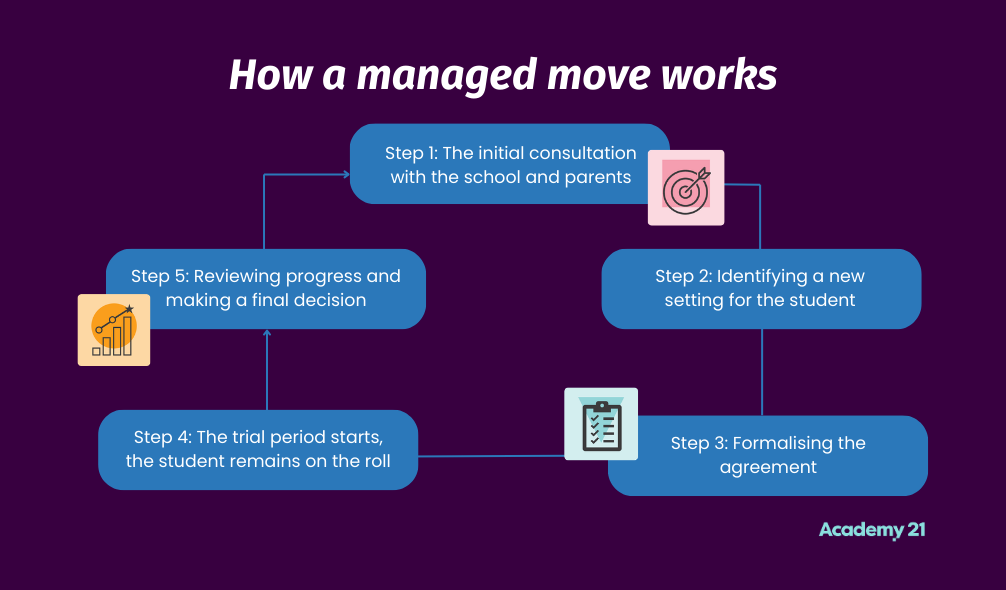
Although there is no single statutory national framework governing managed moves, most successful processes follow a clear and structured pathway.
The process usually begins with an open conversation between the school’s leadership team and the pupil’s parents or carers. At this stage, the school will explain the concerns that have arisen, outline the interventions already attempted, and introduce the idea of a managed move as a possible next step. Transparency is essential here; families need to understand both the challenges and the opportunities that the move represents.
Once there is agreement in principle, the school begins identifying a suitable receiving setting. This could be another mainstream school or an Alternative Provision provider, depending on the pupil’s needs. The decision requires careful consideration of whether the new environment has the capacity, expertise and support structures to help the pupil succeed.
If a suitable placement is found, all parties come together to formalise the managed move agreement. This typically includes the length of the trial period, expectations for behaviour and attendance, the support mechanisms to be put in place, and the review points that will determine whether the move is successful.
During the trial period, the pupil attends the new setting but remains on roll at their original school. Regular communication between both settings and the family is essential to monitor progress, address concerns and ensure that the pupil receives consistent support.
At the end of the trial period, a review meeting takes place. If the placement has been successful, the pupil transfers permanently to the new school or provision. If not, they return to the original school, and further options are explored.
What makes a managed move successful?
Managed moves are most effective when they are carefully planned and genuinely collaborative.
One of the most important factors is the honest sharing of information between schools. The receiving setting needs a full understanding of the pupil’s strengths, challenges, and previous interventions to put the right support in place from the start. When this information is incomplete, the move is far less likely to succeed.
Communication with parents and carers is equally important. Families need clear explanations of expectations, regular updates during the trial period and reassurance that the process is focused on the pupil’s wellbeing and long-term success.
Finally, the pupils themselves should be part of the conversation wherever possible. When young people understand the purpose of the move and feel that their voice is being heard, they are far more likely to engage with the opportunity it presents.
The role of Alternative Provision in managed moves
Alternative Provision is critical for pupils who need a more specialised or flexible educational environment.
AP settings often involve smaller teaching groups, more tailored learning pathways, integrated pastoral support or a curriculum that can be adapted to individual needs. For pupils who have experienced repeated behavioural challenges or disengagement, AP can provide the breathing space needed to rebuild routines and confidence.
The aim is not to lower expectations but to remove the barriers that are preventing a pupil from engaging with education in the first place.
How Academy21 supports managed moves
Academy21 provides a structured and flexible online Alternative Provision model that works particularly well in managed move arrangements.
Through Academy21, pupils remain on the school roll while accessing a DfE-accredited online curriculum for Key Stages 2 to 5, delivered by fully qualified UK teachers. Lessons take place in live, interactive online classrooms, allowing pupils to maintain their academic progress while benefiting from a calmer, more supportive learning environment.
Alongside the academic programme, pupils receive pastoral support designed to rebuild engagement with learning and strengthen wellbeing. For many young people, this combination of structure, specialist support and reduced environmental pressure helps them stabilise behaviour and re-establish positive learning habits.
The onboarding process typically takes one day, allowing schools to act quickly when a situation escalates. This speed can be critical in preventing further incidents and ensuring that a pupil’s education continues without disruption.
In some cases, Academy21 provides a stabilising placement before a pupil transitions back into mainstream education or between managed move placements. Schools use Academy21 on-site at both the previous and new schools to provide consistency and support temporary adjustments to table arrangements, so the student lands well in the new setting. In others, it becomes the setting where the pupil continues their studies in the long term. Either way, the goal is the same: to protect the pupil’s education and create a pathway forward that might otherwise have led to exclusion.
Practical next steps for school leaders
For schools considering managed moves as part of their behaviour and inclusion strategy, a proactive approach is key. Reviewing behaviour data and exclusion patterns can help identify pupils who may benefit from early intervention before situations escalate further. Consulting the Local Authority’s managed move protocol can also provide guidance on best practice and ensure that the process aligns with regional expectations.
Perhaps most importantly, schools should engage parents early and maintain open communication throughout the process. Managed moves rely on trust and collaboration, and families play a crucial role in supporting the transition.
Finally, it is worth exploring how Alternative Provision providers, such as Academy21, can support managed moves as part of a broader inclusion strategy. When used thoughtfully, managed moves are a strategic intervention that can protect a young person’s education and change the direction of their future.