
What are restorative approaches?

Behaviour continues to be a central concern for schools, particularly for pupils who struggle to stay engaged or experience repeated sanctions. Fixed-term exclusions remain disproportionately high for some groups, including pupils with SEND, underscoring the need for approaches beyond traditional behaviour policies.
Restorative approaches have grown in prominence as a way to address the impact of behaviour while keeping pupils connected to learning and relationships. By focusing on dialogue, understanding, and accountability, they provide schools with an additional framework for responding when things go wrong, without replacing existing structures and expectations.
In this blog, we explore why restorative approaches are gaining attention in education, how they work in practice, and the ways schools can embed them to support pupils in repairing relationships, learning from mistakes, and staying engaged with their education.
What are restorative approaches?
Restorative approaches (sometimes referred to as restorative practice) are a framework of principles and strategies designed to repair harm, rebuild relationships and reintegrate individuals into their community following conflict or behavioural incidents.
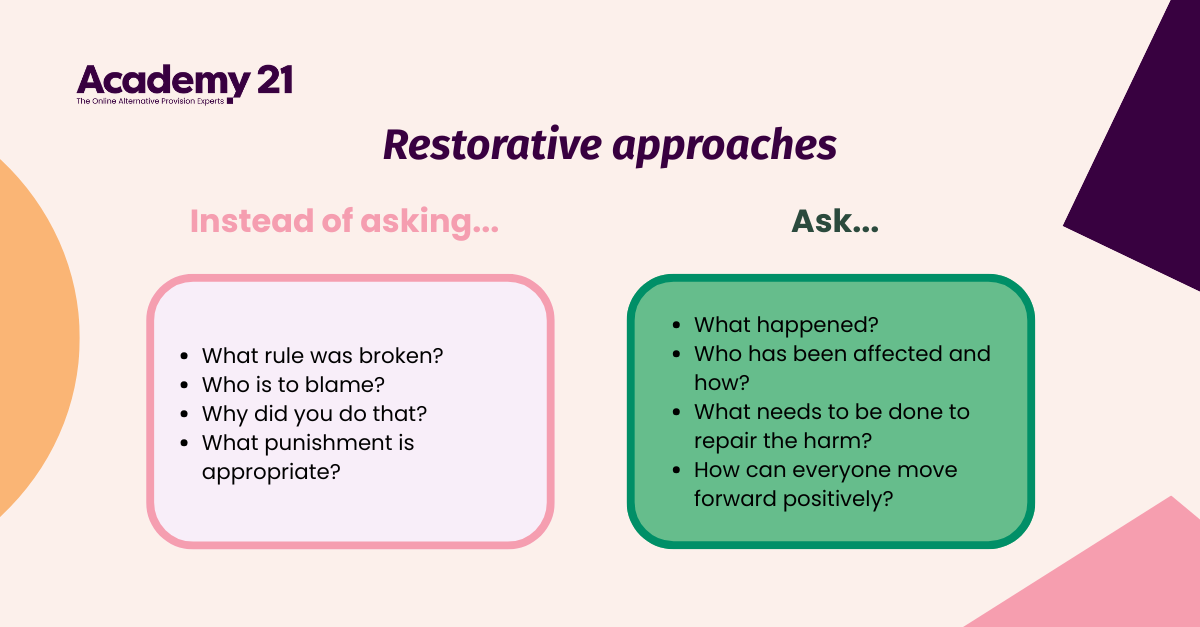
At their core, restorative approaches shift the focus from punishment to understanding and resolution. Instead of asking:
- What rule was broken?
- Who is to blame?
- What punishment is appropriate?
Restorative approaches ask:
- What happened?
- Who has been affected and how?
- What needs to be done to repair the harm?
- How can everyone move forward positively?
This change in emphasis helps students understand the impact of their behaviour on others, take meaningful responsibility and actively participate in putting things right.
Where do restorative approaches come from?
Restorative approaches in education draw their philosophical roots from restorative justice, a model originally developed in community and criminal justice contexts that focuses on repairing harm and restoring relationships rather than relying solely on punishment.
According to a recent review in the International Journal of Environmental Research and Public Health, restorative justice principles have been extended into schools, where they are applied as restorative practices – including circles, conferences, mediation and restorative conversations – to address conflict and behaviour in ways that prioritise connection and positive relationship building rather than exclusion.
The review found that restorative practices promote prosocial behaviours and the development of social and emotional skills such as empathy, communication and accountability, while also contributing to improved school climate and interpersonal relationships.
This emphasis on relational repair and skills development is one reason restorative approaches are increasingly discussed alongside broader educational priorities, such as inclusion, trauma-informed practice, and mental health support, as evidence shows that fostering social and emotional competencies can improve engagement and wellbeing.
How do restorative approaches work in schools?
Restorative approaches work best when embedded in a whole-school culture. Below are some of the most common ways restorative approaches are used in schools.
1. Restorative conversations
Restorative conversations are structured discussions between a member of staff and a student following a behavioural issue or conflict. These conversations are guided by restorative questions and focus on reflection rather than reprimand.
A typical restorative conversation might explore:
- What the student was thinking and feeling at the time
- What has happened since
- Who has been affected by the behaviour
- What the student needs to do to repair the situation
Used consistently, restorative conversations help students develop self-awareness, emotional literacy and problem-solving skills.
2. Restorative meetings and conferences
For more serious incidents, restorative meetings bring together those involved and, occasionally, others affected. These meetings are carefully facilitated to ensure that everyone feels safe, respected and able to contribute. The goal is not to apportion blame, but to create shared understanding and agree on practical steps to repair harm and prevent recurrence.
3. Proactive relationship-building
One of the most important aspects of restorative approaches is what happens before behaviour issues arise. Many schools use restorative language, daily check-ins, circle time and collaborative activities to build trust and strengthen relationships. When students feel known and valued, they are more likely to engage positively with learning and less likely to exhibit challenging behaviour.
What are the benefits of restorative approaches?
- Improved behaviour over time: Because restorative approaches address the underlying causes of behaviour rather than just the symptoms, schools often see a reduction in repeat incidents. Students are supported to reflect, learn and make better choices in the future.
- Stronger staff–student relationships: Restorative approaches encourage open communication and mutual respect. This can be particularly powerful for students who have previously felt misunderstood or labelled because of their behaviour.
- Reduced exclusions and suspensions: Many schools adopt restorative approaches as part of a strategy to reduce fixed-term and permanent exclusions. By keeping students connected to education and addressing issues constructively, schools can minimise disruption to learning.
- Improved wellbeing and inclusion: Restorative approaches align closely with inclusive education practices. They support emotional regulation, empathy and a sense of belonging, all of which are crucial for student wellbeing.

How restorative approaches are applied to online AP settings
Restorative practices are critical in both physical and online AP settings because many pupils have complex needs and disrupted educational histories. They should be woven into the structures that keep pupils connected, supported and progressing academically. Some of the ways in which we apply these principles in our day-to-day at Academy21 include:
Structured induction and consistent expectations
From the outset, students and their learning mentors work with Academy21’s Partnership Managers to set clear expectations around engagement, attendance and communication. This clarity underpins restorative practice online, because consistency and transparency are critical to any conversation about behaviour, impact and responsibility.
2Reflective, facilitator-led interactions built into live lessons
Academy21’s provision is delivered through 100 % live, small-group online lessons with fully qualified teachers. These live sessions create regular, predictable opportunities for staff to engage with pupils in real time, to notice when a learner is struggling and to use brief reflective dialogue to explore what’s going on – in a way that feels supportive rather than punitive. This regularity of contact mirrors restorative practice by emphasising relationship continuity and responsiveness.
Consistent mentoring and wellbeing support
Alongside subject lessons, Academy21 offers additional wellbeing support courses, including one-to-one counselling, anxiety management, and social skills, to help students build resilience, self-awareness, and confidence. These structured sessions provide space for restorative-style conversation – not about “punishment,” but about understanding behaviour, setting personal goals, and developing strategies for future success.
Integration with personalised planning and reintegration
Insights from these conversations and from our Mentor Portal data help shape each pupil’s individual learning plan and reintegration pathways. Academy21’s platform tracks attendance, engagement, and progress, alongside pastoral insights, so schools and staff can see patterns over time and adjust support accordingly. This approach aligns with restorative values by helping pupils take ownership of their learning and behaviour, and by positioning conversations about impact as part of ongoing academic planning.
Using restorative approaches as a foundation for inclusion
Restorative approaches offer schools a thoughtful, evidence-informed alternative to traditional behaviour management. By focusing on relationships and responsibility, they help create environments where students can learn from mistakes rather than being defined by them.
At Academy21, these principles are embedded in online AP delivery. Pupils work with consistent tutors and pastoral staff in small live lessons, participate in structured reflective conversations after incidents or challenges, and use the insights from these sessions to inform personalised learning and wellbeing plans.
If you’re seeking a calm, structured alternative provision model that supports reflection, accountability and re-engagement for any pupil who may be struggling to keep up with their learning, contact our team.