
Targeted support: what does it actually mean in practice?

The latest SEND whitepaper, Every Child Achieving and Thriving, places Targeted Support at the centre of a more inclusive education system, setting out an ambition for earlier identification of need, more prompt intervention, and a reduction in the escalation of challenges into more complex and specialist provision. In principle, this represents a shift towards a more responsive model of education, in which support is provided before difficulties become entrenched rather than after they have already had a sustained impact on learning and engagement.
The idea is that ‘layers’ of support are deployed closely matched to need and enshrined in Individual Support Plans.
In practice, however, the Targeted Support ‘layer’ is also where the system is currently under the most pressure, because although the expectations placed upon schools are defined, the conditions required to deliver consistent and high-quality provision at scale are far more complex.
Schools and local authorities are increasingly working with pupils whose needs do not fit neatly into traditional categories, particularly when attendance has already declined, learning gaps have widened, or engagement has become inconsistent over time.
The question, therefore, is no longer what Targeted Support is in principle, but how it functions when delivered within the constraints, pressures, and expectations of real school environments.
What is targeted support?
Within the reformed SEND framework, targeted support is positioned as an integral part of inclusive mainstream education rather than an escalation route into specialist provision. It is intended to serve as an embedded layer of support that enables schools to respond more quickly and precisely when needs emerge, ideally preventing them from becoming more entrenched over time.
It’s framed as a structured intervention, typically guided by Individual Support Plans developed in collaboration with families and informed by a clear understanding of need. In theory, this should create greater consistency across settings and improve the alignment between identification, planning, and delivery.
The reform publication outlines highly individualised support measures, such as “small-group interventions to develop language skills,” “pre-teaching key vocabulary,” and “managing sensory needs” within dedicated support bases. While these targeted strategies – including personalised materials and speech and language therapy (SLT) – are vital, we must be realistic about implementation. A teacher managing a class of 30 pupils across five periods a day is inherently limited in providing this level of bespoke care. Furthermore, while the new investment is welcome, we must remain pragmatic regarding what a sum of £14,000 to £48,000 per school can actually achieve in radically transforming provision for those with the greatest need.
This also places additional pressure on schools at precisely the point where capacity is already stretched, and where the complexity of need is increasing rather than stabilising. The effectiveness of the wider system, therefore, becomes closely tied to the effectiveness of targeted support itself, because if it is delivered well, fewer pupils will require more intensive intervention later, whereas if it is delivered inconsistently, pressure inevitably shifts upwards into more specialist provision and creates further strain elsewhere in the system.
Layers of Targeted Support
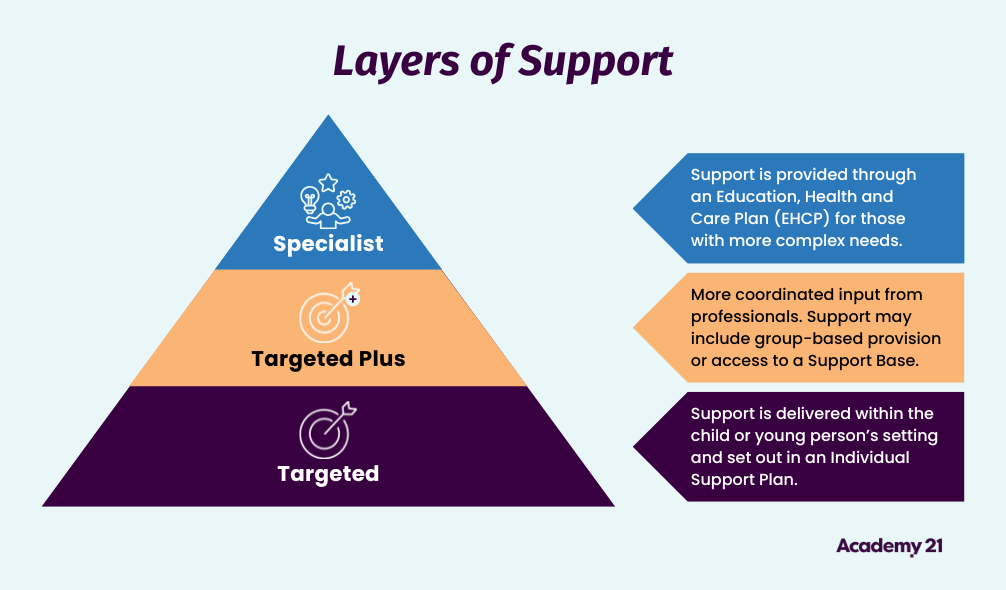
The new White Paper sets out a clearer continuum of support that’s worth understanding:
At the Targeted level, support is delivered within the child or young person’s setting and is set out in an Individual Support Plan, developed with parents and carers. This is intended to address emerging needs early, ensuring intervention is structured, timely, and embedded within everyday provision.
Targeted Plus builds on this by providing more coordinated input from education and health professionals. Support remains based in the child’s setting but may include additional group-based provision or access to a Support Base, offering more focused intervention alongside mainstream learning.
At the Specialist level, support is provided through an Education, Health and Care Plan (EHCP) for those with more complex needs. This may be delivered in mainstream or specialist settings and can include access to nationally defined Specialist Provision Packages or a Specialist Base where required.
Together, these layers create a more graduated system of support, designed to align provision more closely with need and reduce the likelihood of escalation when early intervention is effective.
Why Targeted Support is difficult to deliver consistently
Although there is broad agreement on the importance of early and targeted intervention, delivering it consistently across schools is significantly more challenging. Schools are expected to provide timely, personalised support while simultaneously meeting the needs of all learners within existing constraints of staffing, timetable structure, curriculum delivery, and budget.
At the same time, the nature of need within targeted support is becoming more complex. Many pupils requiring this level of intervention are already experiencing disrupted educational journeys, with significant gaps in prior learning or sustained periods of disengagement. In the case of Academy21, for example, 65% of students arrive with us working well below age-related expectations, which reflects the extent to which targeted support is now being asked to address both foundational and transitional learning needs.
These challenges rarely present in isolation. Instead, they cut across attendance, attainment, wellbeing, and engagement simultaneously, making it difficult for schools to respond using models that assume more linear or predictable patterns of need.
As a result, there is often a mismatch between what targeted support is expected to achieve and the practical conditions under which it is delivered, particularly when provision needs to be both immediate and sustained over time.
What effective Targeted Support depends on
Where targeted support is working effectively, it tends to share several characteristics: it is introduced quickly after need is identified, it is flexible enough to adapt as circumstances change, it maintains continuity of learning so that pupils are not disconnected from the curriculum, and it can be sustained without placing disproportionate pressure on school capacity.
When these conditions are in place, the impact on outcomes can be significant. At Academy21, 94% of students in English, 86% in Maths, and 75% in Science demonstrate sustained academic progress over two terms, while almost half of learners make at least one full level of progress in English during the same period. Alongside this, 93% of students report increased confidence in their learning, suggesting that effective targeted support is as much about re-engagement and self-belief as it is about academic attainment.
However, the challenge remains that achieving this level of consistency across an entire system is difficult without approaches that can flex more readily to meet needs.
Why delivery models matter
If targeted support is to function at scale, it cannot rely solely on fixed in-school capacity, as the timing and intensity of need do not always align with resource availability. In many cases, intervention is required immediately, whereas traditional systems often require time to organise provision, allocate staffing, or secure specialist input.
High-quality online provision is increasingly being used in this context to bridge that gap, not as an alternative to mainstream education but as an extension of it, allowing schools to put targeted support in place more quickly and adjust it more easily as needs evolve.
This is reflected in engagement outcomes, where 324 students increased their attendance by more than 50% after joining Academy21, and 239 learners who had previously recorded zero attendance re-engaged with live education through structured online learning.
Online provision serves as a delivery mechanism for targeted and targeted-plus support, enabling schools and local authorities to respond more effectively to need without unnecessary delay or escalation.

From plan to practice: Implementing Targeted Support with online AP
Delivering personalised learning
A key feature of the SEND reforms is the emphasis on more clearly defined Individual Support Plans, designed to ensure that targeted support is consistently identified, agreed, and delivered.
Online provision offers one way to support this transition from planning to delivery by providing structured, timetabled online lessons, personalised pathways, and ongoing tracking of engagement and progress, all of which help ensure that support is not only defined on paper but also experienced in practice.
At Academy21, this is reflected in Individual Teaching Plans, which align with the principles of Individual Support Plans by tailoring provision to individual needs while maintaining curriculum continuity and accountability for progress.
A key advantage of this approach is that it can be introduced immediately upon identification of the need, reducing the gap between recognition and intervention and helping prevent further widening of learning gaps.
Keeping pupils connected
For some learners, the central challenge is not progression within education but access to it in the first place, particularly where medical needs, anxiety, exclusion risk, or prolonged absence have made consistent attendance in a physical setting difficult or impossible.
In these circumstances, targeted support must extend beyond supplementing classroom provision and instead focus on maintaining continuity of education itself.
Structured online learning provides one way to achieve this. At Academy21, 85% of students who joined with no prior attendance went on to attend and engage in live classes, demonstrating how quickly engagement can be rebuilt when provision is structured to meet learners where they are.
Adopting a joined-up approach
Targeted support is most effective when it operates as part of a wider system of inclusion. Online provision supports this more integrated approach by allowing support to be delivered in a variety of settings, whether within schools, through inclusion bases, as part of targeted intervention, or remotely where required, and by enabling provision to adapt as needs change over time. This flexibility reduces the need for binary decisions between mainstream and specialist provision, instead supporting a more graduated approach to inclusion.
Demonstrating quality, trust and impact
For targeted support to be effective, it must be underpinned by a provision that is credible, quality-assured, and capable of delivering consistent outcomes at scale. Academy21 is an approved provider for over 75 local authorities and a DfE-accredited provision specialist, meeting rigorous standards for safeguarding, teaching, and student support. This level of trust is reflected in outcomes: 95% of schools report that Academy21 meets the needs for which it was commissioned, and the same proportion state they would use the provision again, particularly in relation to engagement, progress, and reintegration.
Bringing it back to Targeted Support
Targeted support is the point at which the ambition of inclusive education is either realised or strained, depending on how effectively it is delivered in practice.
The SEND White Paper sets out a clear direction of travel towards earlier intervention and stronger support within mainstream education, but the success of that ambition will ultimately depend on whether schools and systems can translate intent into consistent delivery.
High-quality online provision is already playing a role in that space by extending the capacity of schools to respond to need in real time, supporting continuity of learning, and enabling more flexible and timely intervention.
If you would like to learn more about how Academy21 can help you meet the new requirements set out by the SEND policy paper, reach out to our team.
The question, therefore, is not whether targeted support is the right direction for the system, but whether the system is prepared to use the full range of tools required to make it work in practice for every child who needs it.